In 81 BCE, at the court of Emperor Zhao of Han, a fierce debate broke out between Sang Hongyang, the imperial finance minister, and a group of Confucian scholars summoned from across the empire. The official pretext for the assembly was "to inquire into the sufferings of the people." The real question was narrower and sharper: should the state monopolies on salt and iron continue?
Sang's position was brutally pragmatic. The frontier demanded silver. The empire needed revenue. Leave the trade to private hands and the treasury collects nothing. Therefore: state monopoly.
The Confucian scholars' indictment was equally concrete. The state-made iron implements, they argued, "cannot cut grass; their axe heads chip and break." Farmers were forced to use inferior tools. The salt and iron officers "extracted without limit," bankrupting small producers. The state, by entering commerce itself, corrupted public morals.
This debate is usually read today as a clash between statism and laissez-faire. But look closely at the text — the question is not the abstract one of whether the state should intervene in the economy. The question is narrower and more specific: as a monopoly operator, what did the state-run salt and iron enterprise take on, what did it shirk, and who paid the cost?
The Confucian critique was not aimed at the Han state itself. It was aimed at the salt and iron officers as monopoly operators — they occupied the market, collected the profits, but offloaded every responsibility that came with an industry's public goods: product quality, distribution reach, honest pricing.
Two thousand years later, looking at the crypto industry, one finds an almost isomorphic scene. An industry that claims to bypass the state and govern itself through code is replaying, at the level of its leading firms, the exact same argument: can you simultaneously grow the industry, hold onto dominant market share, and refuse to bear the cost of industry public goods?
This essay argues: no.
1. Why You Cannot Have All Three
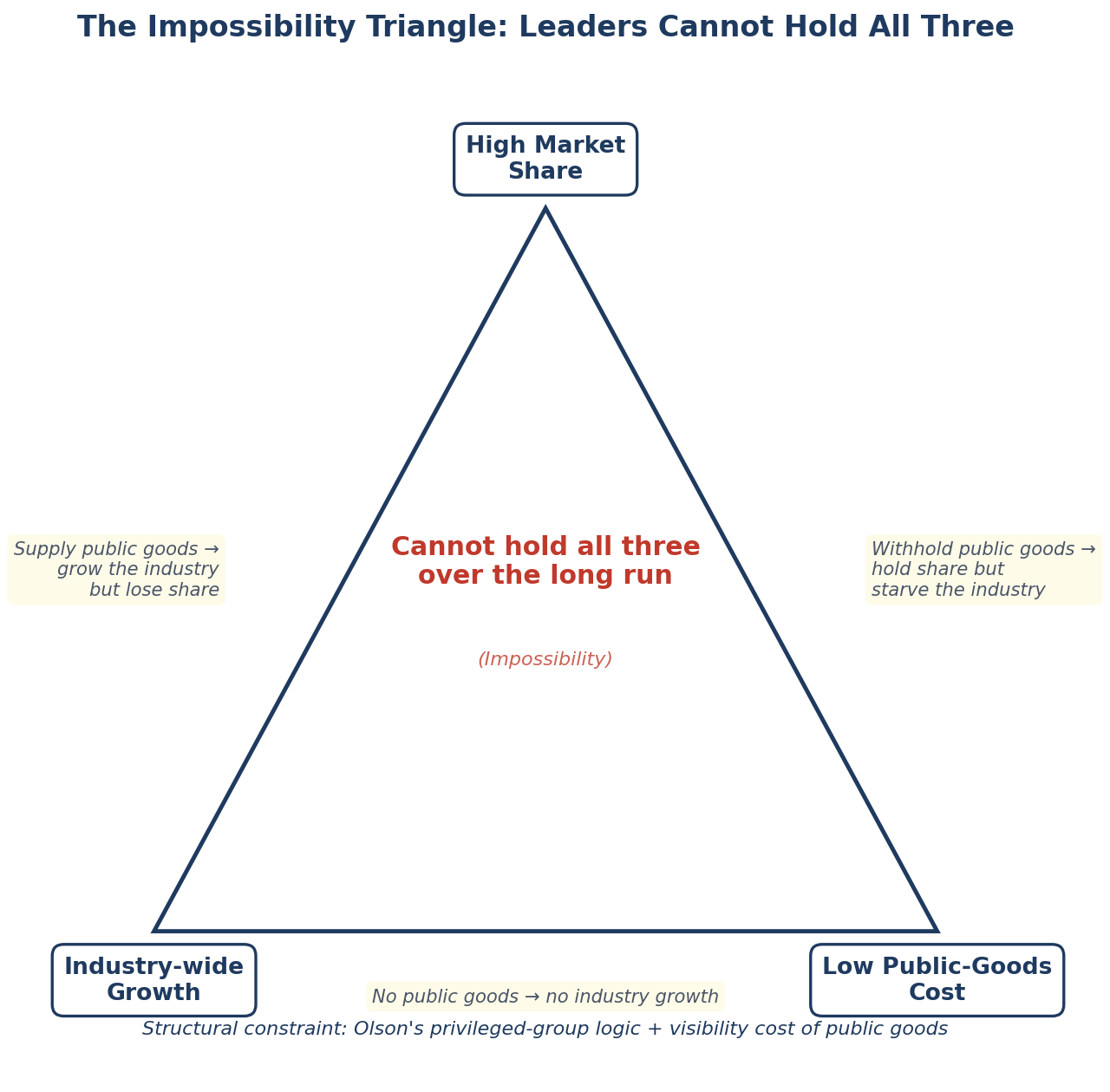
In an industry that lacks an external provider of public goods, no single leading firm can long sustain all three of: high market share, positive industry-wide growth, and low public-goods investment.
These three goals form an impossibility triangle. To see why, we first need to pin down what "public goods" means here.
In crypto — the economy I described in a previous essay as "lacking a lender of last resort" — industry-wide growth depends on a bundle of non-excludable public goods:
- Regulatory legitimacy: a framework that institutional capital can safely enter
- Protocol and interoperability standards: rails that let developers and capital move across ecosystems
- Liquidity depth: the precondition for price discovery and risk management
- Early-stage risk capital: the seeds of the next cycle
- Cycle-stabilization mechanisms: something that prevents collapses from cascading into systemic wipeouts
In traditional economies these public goods are supplied by the state or by private actors under state regulation — the Fed as lender of last resort, the SEC as disclosure regulator, exchanges as standard-setters. In crypto, this economy without a state, the question of who provides them hangs open.
Mancur Olson's logic of collective action gives us the answer. Among a group of beneficiaries, the member with the most unequal stake has the strongest incentive to provide the public good unilaterally — because his marginal payoff is the highest. Structurally, then, only industry leaders will supply public goods. Everyone smaller rationally free-rides.
This defines the structural position of the leader: providing public goods becomes its "tax" — it bears the cost, others consume the benefit.
Public-goods provision carries two kinds of cost. The first is direct: money, attention, compliance budgets, audit fees. The second is visibility cost: regulatory attention, antitrust focus, politicization risk, the chains of being watched. Visibility cost erodes dominance nonlinearly, because it converts implicit power into explicit responsibility.
So the logic of the triangle becomes clear:
- If the leader provides public goods → compliance constraints and jurisdictional boundaries cap its expansion → market share hits a ceiling
- If the leader withholds public goods → the shortfall eventually gets settled all at once → market share is halved and only partially recovers
- Neither path preserves "high share + industry growth + low public-goods cost" simultaneously
Note that this argument doesn't depend on leaders being lazy or shortsighted. Even with full rationality and perfect information, the structure itself makes the triangle unachievable.
It is a sharper claim than the familiar "monopolists who don't innovate get disrupted." It is not a timing problem. It is a structural one.
One corollary worth flagging up front: the triangle is a constraint, not a promise. It says you cannot have all three. It does not say providing public goods will make you win. Both strategies come with their own ceilings, their own costs. The case studies below return to this point repeatedly.
2. Two Ways to Live in Every Category
The claim holds in every major crypto vertical. Look at the top two players in each, and the same pattern appears.
Every category has two leaders coexisting — one on the low-public-goods path, one on the high-public-goods path. They are not sequential phases; they are a spatial division of labor that has held stable for a decade or more.
Stablecoins: Where the Growth Flows Matters More Than Who's Number One
The contrast between Tether (USDT) and Circle (USDC) is textbook.
USDT's strategy. Tether chose the low-public-goods path. Reserves are attested quarterly by BDO Italia — not a full third-party audit. Tether refused to comply with MiCA; after the EU's MiCA regime came fully into force at end-2024, USDT was delisted from major European CEXes. In October 2021, the CFTC fined Tether $41M for reserve misrepresentation, officially finding that "Tether reserves were fully-backed for only 27.6% of the days in a 26-month sample period between 2016 and 2018." Tether moved its domicile from the British Virgin Islands to El Salvador, systematically selecting the jurisdiction with the lowest regulatory cost.
USDC's strategy. Circle chose the opposite path. Deloitte publishes monthly reserve attestations. Reserves sit primarily in a BlackRock-managed money market fund under SEC oversight. Circle actively adapted to MiCA, becoming one of the first globally compliant USD stablecoins. When SVB briefly depegged USDC in 2022, the de-pegging and recovery were publicly disclosed in full.
How does the triangle settle these two strategies?
The telling metric isn't absolute market cap. It's where the marginal growth flows when the industry expands.
In January 2025, total stablecoin market cap was roughly $205B. By April 2026, it had reached $320B — net growth of $115B, a 56% expansion. This is the largest bull run in stablecoin history, driven by institutional capital entering after the GENIUS Act.
And in this expansion, USDT is not the primary beneficiary.
- Over 2025, USDC grew 72%, USDT grew 36% — USDC's growth rate was double Tether's
- USDT's share of stablecoin market cap fell from 60%+ at the start of 2024 to 57.96% by April 2026 — still number one, but in continuous decline
- In January–February 2026, Tether recorded its first consecutive monthly market cap contraction since FTX, burning 6.5 billion USDT
- The most striking data point is on the transaction-volume side — in March 2026, USDC captured 64% of stablecoin transaction volume for the first time in nearly a decade, surpassing USDT (per CoinMarketCap tracking)
- Institutional rails — Visa, Mastercard, BlackRock settlement and treasury operations — prefer USDC
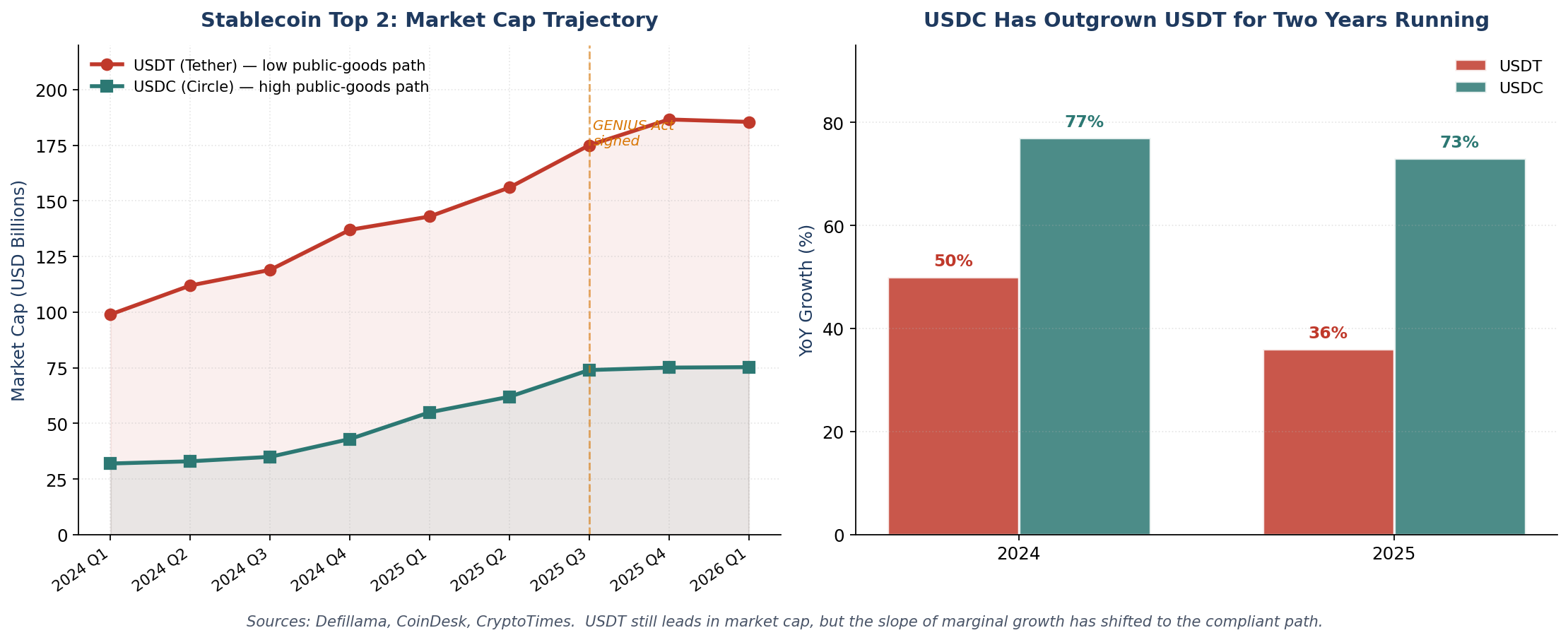
This is how the triangle operates: when the industry expands, the marginal growth is not distributed evenly. It flows disproportionately to the provider of compliance public goods. USDT has not lost its existing users — the crypto trading base, the USD substitute in emerging markets. But it is almost entirely excluded from the fattest segment of the 2025–2026 expansion. Tether's Q2 2025 net income was $4.9B — it remains a profit machine. Its problem isn't earning power. Its problem is that the slope of the growth curve has transferred to someone else.
In October 2025, Tether announced USAT — a product specifically designed for GENIUS Act compliance. That announcement was Tether's implicit admission: without public-goods investment, the new-volume arenas cannot be held.
Exchanges: Two Different Ceilings, Each With Its Price
The public discourse often reduces this pair to "the compliant one won, the non-compliant one lost." The data is more complex than that, and more instructive about what the triangle actually constrains.
Binance's moment of settlement.
On November 21, 2023, Binance reached a sweeping settlement with the DOJ, FinCEN, OFAC, and CFTC — a combined $4.3B in penalties — the largest enforcement action in Treasury and FinCEN history. The Treasury's official statement describes Binance as "the world's largest virtual currency exchange, responsible for an estimated 60% of centralized virtual currency spot trading" — primary-source confirmation of the peak market share.
CZ stepped down as CEO, paid $50M personally, and was sentenced to four months in prison in April 2024. Binance's early growth model — "global, low-friction, expansive listings" — had been ruthlessly effective in the industry's formative years. But one of its costs was deferring investment in compliance infrastructure: KYC, AML, sanctions, jurisdictional registration. The DOJ settlement was, in effect, that deferred cost settled all at once.
The market's reaction was clear and drawn out. Per CCData, Binance's spot market share fell to 27% in September 2024 — its lowest since January 2021 — and dropped further to 25% by December 2024. Binance then did two things: appointed Richard Teng as new CEO (former head of markets at the Abu Dhabi Global Market, former senior regulator in Singapore), and seated its first independent board of directors.
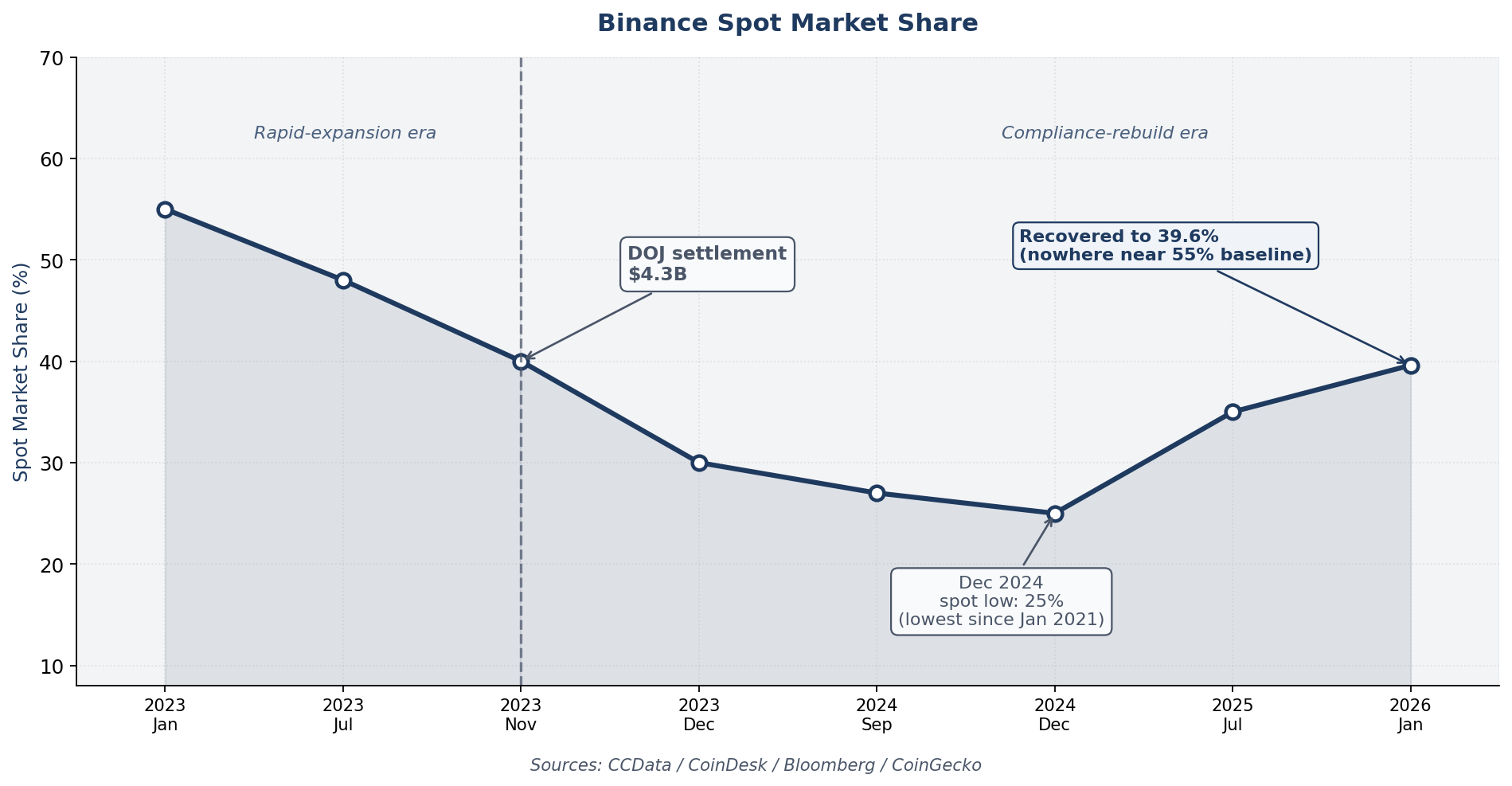
In other words, post-settlement, Binance was forced to supply the compliance public goods it had previously skimped on. Once it did, Binance's spot share recovered to a cumulative 39.6% over August 2025 to January 2026 — back to number one globally, but nowhere near the 60% peak.
Coinbase's ceiling.
Coinbase walked the opposite path. A voluntary IPO in 2021 — into full SEC disclosure. A public stand against the SEC's 2023 Wells Notice, using litigation to force legal clarity. The Base L2 as public infrastructure. Active lobbying for the CLARITY Act.
But the ceiling on this path is lower than most people assume.
Inside the U.S. market, Coinbase is a fortified oligopolist. Per CoinGecko data from 2023, Coinbase holds around 76% of U.S. web traffic among centralized exchanges — "2 to 3 out of every 4 U.S. crypto users are on Coinbase." The institutional side is even more concentrated. In its Q2 2025 shareholder letter, Coinbase disclosed: "Coinbase is the custodian for over 80% of U.S. BTC and ETH ETF assets as of the end of Q2" — over 80% of U.S. BTC and ETH ETF assets held by Coinbase alone, with assets under custody of $245.7 billion.
But shift the lens from "U.S. market" to "global market" and the picture changes entirely. Per CoinGecko's 2025 Q3 report, Coinbase has fallen to #10 among global centralized spot exchanges — even as it remains the largest in the U.S. Its global footprint depends on derivatives and international expansion, not its core U.S. spot business.
This contrast is revealing: the cost of actively choosing the compliance vertex is not lost market share — it is a surrendered "global scale" vertex. Coinbase's TAM is bounded by "what U.S. regulators will accept." Inside that boundary, it is nearly a monopoly. But that boundary itself only covers a small slice of global crypto trading volume. Compliance is not free — its price is a geographic and jurisdictional ceiling.
Kraken further illustrates that the return on compliance is not linear. Within a year of FTX's collapse, Kraken's share among USD-deposit-supporting exchanges rose from 8.3% to 21.1%, while Coinbase's U.S. share rose by less than one percentage point over the same period. Choosing the compliance vertex does not automatically deliver market share. It only spares you a Binance-style one-time settlement.
The complete picture of this pair: Binance chose "high share × industry growth" — and paid in deferred-compliance settlement. Coinbase chose "compliance × stable position" — and paid in global scale foregone. Both paid. Neither escaped the triangle.
Layer 1s: Refusing to Have a Head Is Itself a Choice
The BTC-vs-ETH contrast is the most theoretically instructive, because they represent the two extremes of "public-goods provision."
BTC's path is: refusing to acknowledge that a leader exists. No foundation (the Bitcoin Foundation was marginalized long ago). No CEO. No designated counterparty for outside negotiation. Protocol governance is deliberately ossified — the BIP process demands near-consensus, and any "active governance" is read by the community as betrayal of decentralization.
This is the purest form of the low-public-goods path. Its cost: all the public goods that a leader would normally supply have been outsourced to the outside world — chiefly, to the dollar system.
- Regulatory legitimacy: supplied by BlackRock's IBIT and ten other spot BTC ETFs — by October 2025, IBIT alone had approached $100B in AUM, holding over 800,000 BTC
- Institutional access: supplied by CME futures, Fidelity custody
- Credit layer and unit of account: supplied by Strategy's STRC and similar preferred-stock products — STRC is a perpetual preferred with a USD par, monthly USD dividends, and an 11.5% annualized yield, repackaging BTC as a USD-denominated fixed-income product
- Sovereign legitimacy: supplied by the SBR — the U.S. Strategic Bitcoin Reserve
BTC has indeed achieved "high share + no public-goods investment" — but it has done so by letting BTC stop functioning as industry infrastructure. DeFi isn't built on BTC. Stablecoins aren't issued on BTC. Applications don't run on BTC. BTC remains rock-solid as an independent asset class, but its relevance as the industry's platform has steadily declined.
ETH's path is the opposite. The Ethereum Foundation takes on protocol coordination. Devcon aligns the community. The EIP process provides transparent technical governance. The grants system allocates ecosystem public-goods funding. These are unambiguous public-goods investments.
The cost: EF bears simultaneous pressure from both directions — complaints that it "does too much" (token economics) and that it "does too little" (L2 sequencing, MEV). But it is precisely this layer of coordination that makes ETH the default base layer for the majority of DeFi, stablecoins, and RWA applications.
This pair reveals an important corollary of the triangle: when a leader refuses to supply any public goods, it doesn't get disrupted — it gets routed around. Its role as the industry's platform passes to whoever does supply them.
BTC wasn't disrupted by ETH — they coexist. But BTC ceded the identity of "industry infrastructure" to ETH (and later Solana), in exchange for its stability as "digital gold." That was a structural retreat.
3. Not a Timeline Problem — A Division-of-Labor Problem
Lined up side by side:
| Category | Low-Public-Goods Path | High-Public-Goods Path |
|---|---|---|
| Stablecoins | USDT — minimal attestation, non-MiCA | USDC — monthly audits, active compliance |
| CEX | Binance — deferred compliance until settlement | Coinbase — voluntary IPO, CLARITY advocacy |
| L1 | BTC — refuses leadership | ETH — EF bears protocol coordination |
A reader might object that this is just the standard "industries are chaotic early, then they get regulated" pattern — true of late-Qing banking, true of early internet, true of every industry. But the crypto pattern is actually more specific, and more worth analyzing.
This is not a stage on a timeline. It is a division of labor in space.
The traditional "early chaos → mature compliance" transition usually happens at the industry level — regulation enters, and the industry as a whole moves from anarchy to rules. The 1930s American stock market, the 1990s Chinese internet, and so on. Crypto does not do this. Crypto has two leaders, with two different strategies, coexisting — and this split is stable, not transitional.
USDC and USDT have coexisted for 8 years, both Top 2. Coinbase and Binance for 10 years, both Top 2. ETH and BTC for 11 years, both Top 2. Over windows this long, there is no case of "the number one eventually imitated the number two" (or vice versa) — no convergence. These are two different business models coexisting, serving different user preferences, different jurisdictions, different risk appetites. Not a sequence.
Why is it that in each category, the compliant player is always number two, not number one?
Because public-goods investment is the only lever a latecomer has to pry at an incumbent's dominance. The incumbent's moat is network effects, liquidity, brand. The latecomer cannot compete on those directly — it has to open a new dimension: "I am compliant and you are not; I am transparent and you are not; I coordinate and you do not." These are all public-goods investments. Not moral superiority — forced differentiation.
And incumbents cannot easily pivot. Once the brand and the public identity are built on "low rules, high speed, global reach," any move toward compliance is read by the market as a wavering of conviction — users leave, employees leave, the narrative cracks. Only when external pressure reaches a breaking point (DOJ settlement, MiCA delisting) does the incumbent belatedly comply.
Returning this updated pattern to the triangle:
- Top 1 sustains high share + low public-goods investment → at the cost of losing the slope of growth to Top 2, or a forced catch-up at some threshold
- Top 2 sustains public-goods provision → at the cost of geographic and jurisdictional ceilings; share growth depends on external regulatory tailwinds
- Both live inside the triangle — they have merely chosen different pairs of vertices
And this, in turn, returns us to the sharpest point in the Discourses on Salt and Iron. The Confucian scholars were not attacking "the state" as such. They were attacking a monopoly operator that had chosen a particular strategy. They knew, explicitly, that under the same industry, private operators (like the Zhuo clan of Linqiong in early Han private iron) had made sharper tools, at lower cost, with broader distribution. The claim was not "private is always better than state" — it was specific strategies produce specific consequences. Crypto's triangle is the same observation.
4. The Frontier Is Always Where TradFi Won't Go
So far the triangle has led us to a somber conclusion: the structure of crypto keeps it dependent on the dollar system for its public goods. My previous essay, From Korea's Reintegration to the Compute-Dollar, made the same argument at the macro level. But something happened in April 2026 worth adding as a qualifying footnote.
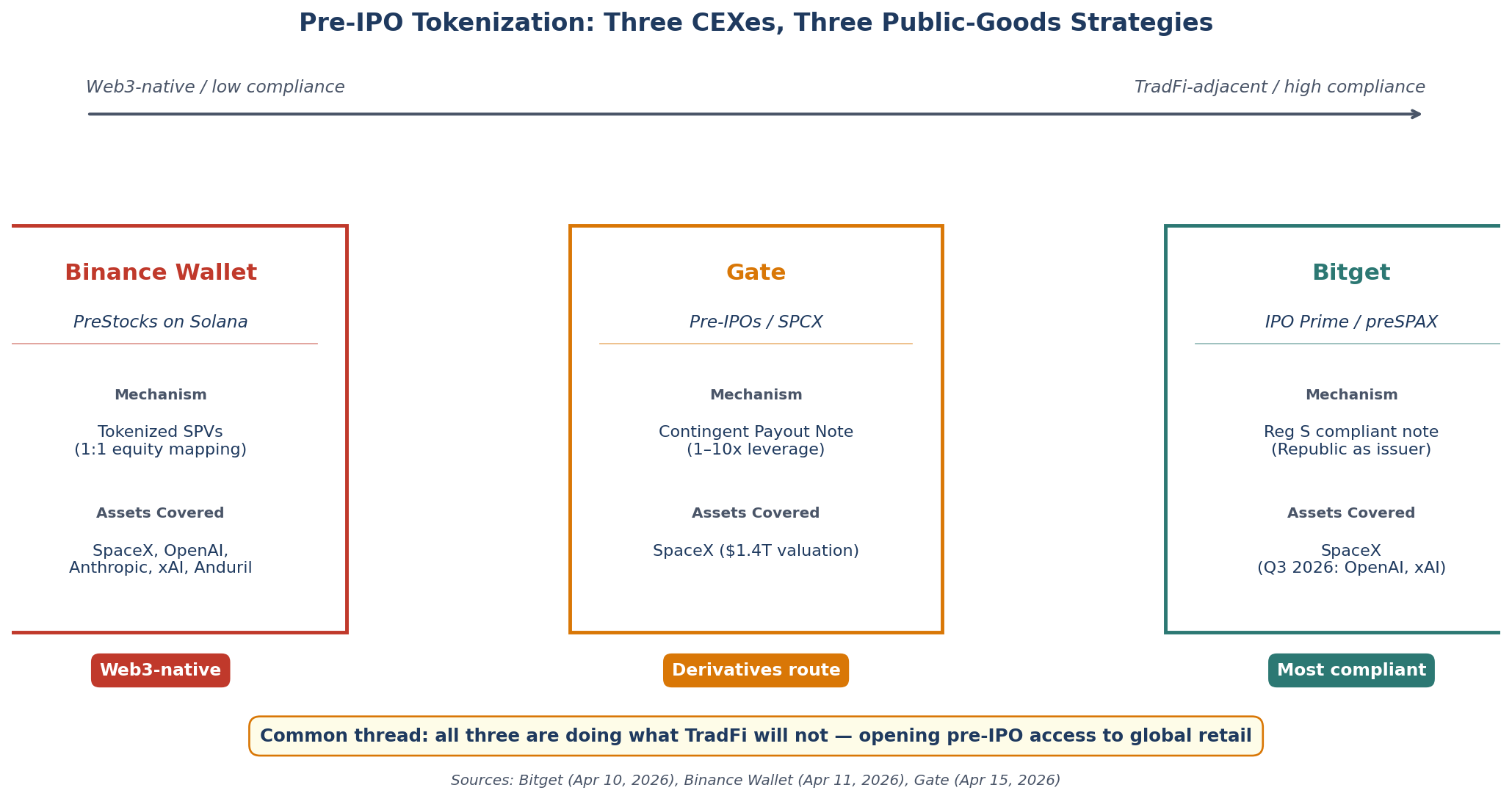
On April 10, Bitget launched IPO Prime. Its first product, preSPAX, is a SpaceX-exposure token issued through a partnership with the licensed securitization platform Republic, structured under Regulation S, denominated and subscribed in USDT. Global retail can access it with a $500 minimum. On April 11, Binance Wallet listed five pre-IPO assets — SpaceX, OpenAI, Anthropic, xAI, Anduril — via the PreStocks protocol on Solana, using an SPV 1:1 equity-mapping token structure. On April 15, Gate launched its Pre-IPOs product, SPCX, a USDT-settled Contingent Payout Note supporting 1–10x leverage.
Three firms. Three different structures. All in the same week. All competing for the same outcome: making pre-IPO assets — previously accessible only to VCs and accredited investors — available to global retail.
A few observations are worth recording.
First, this is something TradFi will not do. U.S. pre-IPO platforms like Forge Global and EquityZen only serve accredited investors with $1M+ net worth. Retail investors in Europe, Asia, Latin America — even those willing to put in a few hundred dollars — simply cannot access the valuation curves of SpaceX or OpenAI. This is not a technical problem. It is a choice: TradFi's infrastructure, regulatory pathways, and compliance costs do not support the combination of "global retail × high-valuation private assets." Crypto is filling a gap TradFi has declined to fill.
Second, this is itself a new form of public-goods investment. The underlying technical stack for pre-IPO tokenization — SPV architecture, legal wrappers, global compliance registrations, cross-jurisdictional settlement — is an expensive bundle of infrastructure. Bitget, by partnering with Republic under Reg S, is actively exposing its largest regulatory surface area to the U.S. system. Gate, with a Contingent Payout Note structure, is taking on derivatives-settlement responsibility itself. Binance Wallet, with the Solana SPV route, is building bottom-up compliance engineering in a Web3-native direction. None of the three is a "no-risk" option. All three are actively assuming a public-goods role that TradFi refuses to take on.
Third — and this is the most important — none of these firms is the Top 1 in the verticals analyzed above. Binance is the Top 1 exchange, but the pre-IPO play is coming out of Binance Wallet, a flank. Bitget and Gate are second-tier in spot market share. The industry's innovation frontier often does not come from the Top 1's main position. It comes from second-tier players opening up new dimensions.
This is exactly consistent with the triangle's logic. Top 1 is under enormous structural pressure to maintain its core position — any disruption in any dimension threatens it. Top 2 and second-tier players have every incentive to take risks in new dimensions — because without doing so, they will never catch up.
Stacked against crypto's 17-year history, a more optimistic narrative emerges: crypto natives, while being "Keynesianized" on their existing turf, keep opening new frontiers of public-goods supply. Stablecoins were not built by TradFi. Layer 1s were not built by TradFi. DeFi was not built by TradFi. And now pre-IPO tokenization — still not built by TradFi. Each of these openings extends the answer to the question "What can crypto do that TradFi cannot?"
This is not to say crypto will "become independent of the dollar system" — my previous essay already argued it will not. But crypto can, within the extensions of the dollar system, continue to supply public goods that TradFi cannot. That is the competitive position of the crypto native — not to reject compliance, not to refuse being absorbed, but to be the first to build infrastructure in every dimension TradFi will not, cannot, or dare not touch.
Sang Hongyang, in the Discourses, said something that reads very pointedly today:
"Wealth lies in stratagem, not in labor of the body; profit lies in commanding position, not in the plough's exertion."
(富在术数,不在劳身;利在势居,不在力耕)
His meaning: real wealth comes from institutional design and position-selection, not from effort itself; real profit comes from occupying key nodes, not from repeating labor. Two thousand years later, transposed to crypto, the same sentence reads: the competition at the top is not about out-laboring one's rivals on existing dimensions. It is about being first to occupy the key node on a new one.
The triangle is a structural constraint. But what it constrains is "having all three at once." It does not constrain "starting over on a new dimension." Every dimensional expansion is a reset of the triangle.
And every reset, so far, has been reached first by crypto natives.